
Acquisition of land or parcels in the fast developing NCR regions appears to be appealing to numerous investors. Increasing population and growing cities coupled with improved roads systems render the outskirts of Delhi NCR an attractive investment destination in the future. However, booking sums and any contract that buyers conclude are based on one crucial term: CLU in Property.
When developers talk about CLU approvals, future conversion or future residential permissions, many people listen to them. Nonetheless, not all purchasers are aware of what CLU in Property entails or its impact on the safety of land. Incomplete approvals, absent land records or falsified promises pose significant risks in certain situations.
This paper defines CLU in Property, typical abuse in NCR real estate, the land records that are required to be checked and how individuals can safeguard themselves prior to investing.
Table of contents
- What CLU Property?
- The importance of CLU in Property in NCR Real Estate.
- Before CLU in Property, Land Records are Compulsory.
- CLU in Property Is Misused in NCR Real Estate.
- Land Conversion illegally in the area around NCR: Red flags.
- Before purchasing property, how to Check CLU Status.
- In the NCR Outskirts, there are property Investment Risks.
- Safe Investment Smart Buyer Checklist.
What CLU Property?
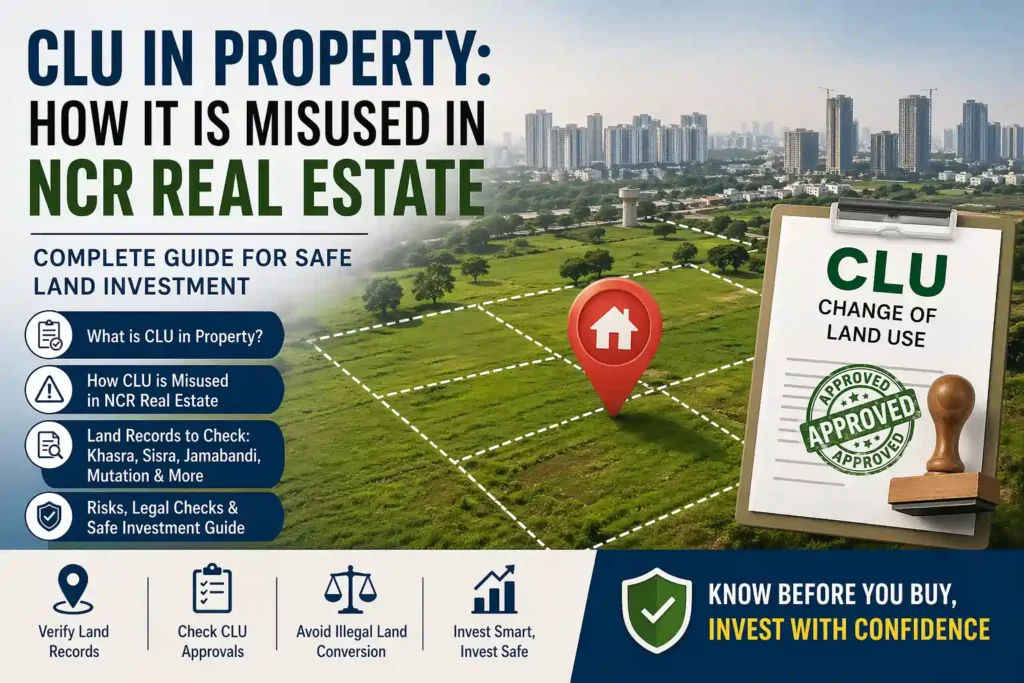
CLU on the Property is abbreviated as CLU. It is the formal legal procedure by which land designated as one type is converted to another by government authorization.
Examples include:
- Farmland to residential.
- Commercial use of agricultural land.
- Industrial to institutional land.Land development of mixed-use approvals.
When land is agricultural, it might not necessarily be converted to accommodate colonies and commercial projects. It is the reason why CLU in Property is significant to the developers, investors, and homebuyers.
The future construction, resale, financing or occupancy can be problematic without adequate CLU in Property.
For Verified land deals Call Now
The importance of CLU in Property in NCR Real Estate.

NCR has spread out of core cities to neighbouring districts and growth corridors. This has resulted in the demand of plotted developments, builder floors, warehouses, and townships.
Due to this development, CLU in Property has emerged as one of the most talked-about topics in land investment.
Proper CLU in Property Benefits.
- Conversion of legal land use.
- Better resale potential
- Less rigorous development-approvals.
- Higher buyer confidence
- Increased likelihood of bank financing.
- Reduced dispute risk
CLU in Property can enhance the usability and value of land in the long term when approvals are real.
Before CLU in Property, Land Records are Compulsory.
One of the greatest errors that buyers commit is verifying CLU claims before they verify ownership records.
Even when one claims that CLU is condoned, land title issues may still cause conflicts. This is the reason behind land records before believing any project.
Compulsory Land Records to verify.
Khasra Number
The Khasra number is used to identify the particular piece of land in the revenue records. It ensures the precise land location and area.
Shajra / Sisra Map.
The Shajra map (also known as Sisra locally) indicates land boundaries and road accessibility and neighboring parcels.
Jamabandi
Jamabandi is the register of ownership which indicates the legal owner of the land.
Mutation
Mutation is the transfer of property upon sale, by inheritance, or by partition. In case a mutation is imminent, the clarity of ownership might be low.
Sale Deed / Registry.
Registry papers validate transfer conditions and the legitimacy of transactions.
All these records must be correct before using CLU in Property.
Also Explore: Naugaon Farmhouses
CLU in Property Is Misused in NCR Real Estate.
In fast developing markets, CLU in Property has also been employed as a marketing concept rather than a fact of law.
1. Sales Before Final Approval.
Certain sellers claim that CLU is in process or coming soon. Buyers assume that it is guaranteed. No buyer should solely depend on verbal assurances until final documents are produced.
This is a typical problem of CLU abuse NCR real estate.
2. Plotting Agricultural Land
Farmland can be split into lots and be sold as residential investment in the future. Buyers can find themselves delayed or hampered without valid CLU in Property.
3. Hidden Ownership Problems
Future development can be held up even with CLU being alleged because the Jamabandi, Mutation, or Khasra disputes remain unresolved.
4. Price Hype on Rumors.
Prices can be inflated at times due to rumors of future approvals, rather than actual orders.
5. Misleading Documentation
There are also projects which present brochures yet do not provide the real copies of approval.
Land Conversion illegally in the area around NCR: Red flags.
One of the biggest concerns for buyers is the unlawful conversion of land around NCR. It implies that land is either being used or sold against the legal approval.
Red Flags to Pay Attention to.
- Rates are very low in comparison with adjacent land.
- None of the CLU copies found.
- Missing Khasra details
- None on map.
- Urgent booking pressure with offers.
- Unclear ownership chain
- No new Mutation record.
In case these indicators occur, check each statement thoroughly.
Before purchasing property, how to Check CLU Status.
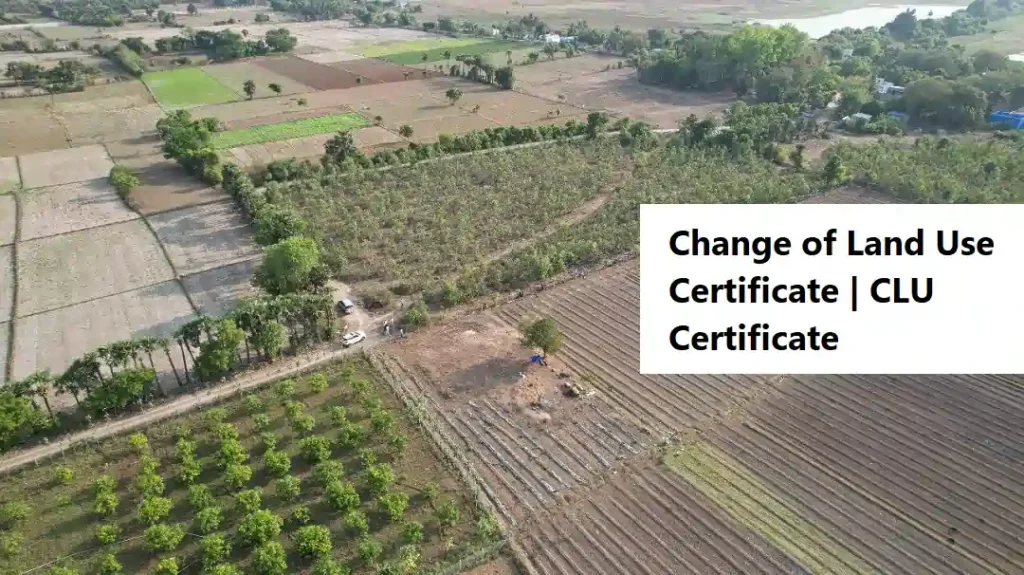
Most investors are inquisitive on how to verify CLU status before purchasing property. Follow this real-world checklist.
1. Request Copy of CLU Approval.
Never trust verbal assertions. Ask to approve written approval documents.
2. Match Khasra Numbers
Make sure that approvals parcels of land are the same as that which is being offered.
3. Verify Jamabandi
Establish ownership and legal possession.
4. Check Mutation Status
The transfers of ownership should be revised in documents.
5. Review Shajra Map
Physical boundaries, access roads and precise location.
6. Consult Legal Expert
CLU can be reviewed by a property lawyer under Property and title risks.
Looking for CLU-approved land or bulk land deals? WhatsApp us today
In the NCR Outskirts, there are property Investment Risks.
Low prices may be appealing, yet there exist actual risks of investing in real property in the outskirts of NCR.
- Common RisksDelayed infrastructure
- Ownership disputes
- Unapproved land use
- Rejection of loans by banks.
- Poor resale demand
- Regulatory action
- Long legal disputes
This is the reason why savvy investors check CLU in Property before making a purchase.
Safe Investment Smart Buyer Checklist.
Before handing over token money:
- Check CLU in Property documents.
- Check Khasra and Jamabandi.
- Confirm Mutation update
- Review Shajra map
- Check title history
- Compare market price
- Check road and utility access.
- Use legal verification
- Avoid rushed decisions
Conclusion
The concept of CLU in Property is vital in ensuring safe investment in NCR real estate. But CLU is not sufficient. Khasra, Shajra, Jamabandi, Mutation, registry papers and chain of ownership must also be verified by buyers prior to payment. There are numerous losses incurred when investors believe in promises rather than documents. By appropriately examining CLU in Property, preventing illegal conversion of land around NCR, understanding how to check CLU status before purchasing property, and understanding property investment risks in NCR outskirts, you can make better and safer decisions in investment.
FAQS
1. What is CLU in Property?
CLU in Property refers to Change of Land Use, whereby land which has been legally converted by means of official governmental approval, is legally changed to residential or commercial use.
2. What is the importance of CLU in Property before purchasing land?
CLU in Property is significant in that it assures whether the property can legally be used in the purpose that is being advertised. Buyers can end up in legal problems, delay in construction or problems with resale without proper approval.
3. What to do to establish the CLU status prior to purchasing property?
CLU in Property: To confirm the CLU in property, request the official approval letter, compare the Khasra numbers, examine Jamabandi and Mutation records and verify the details by the concerned authority or by a legal expert.
4. What are the typical indications of CLU abuse NCR real estate?
Indicators such as selling projects prior to their approval, development of agricultural land, lack of ownership documents, unrealistic promises of returns, and unwillingness to provide legal documents are common.
5. What are the risks in investing in NCR outskirts?
Clear land title, illegal conversion of land around NCR, late infrastructure development, lack of demand to resell, financing, and future court battles are some of the major property investment risks in the outskirts of NCR.