
Farmhouse or agricultural land is getting popular as an investment option in India, particularly in and around the fast growing areas such as Gurgaon, Noida and other sections of Delhi NCR. The concept of open space, long-term appreciation, and serene weekend life attracts buyers.
Nonetheless, even though most projects are valid, the real estate business should be scrutinized as well. Farmhouse deal scam is a common internet term, however, in practice, risks typically occur due to failure to conduct due diligence, ambiguous documentation or regulatory failure, and not due to the idea of farmhouse investment.
This paper discusses 5 factual, legal warning signs that all buyers must check prior to investing in any farmhouse or agricultural land transaction.
Table of contents
- 1. Certificate of Title Chain and ownership of land that is not verified.
- 2. Deficiency in Clarity in Land Use Classification.
- 3. Lack of Government or Authority Approvals that can be verified.
- 4. Unfinished or unofficial Transactions Process.
- 5. No Physically Verifiable Land or Site Details.
- Learning the difference between Risk and Fraud in Farmhouse Deals.
- The Following Best Practices to make a safe farmhouse investment.
Also Read: CLU in Property
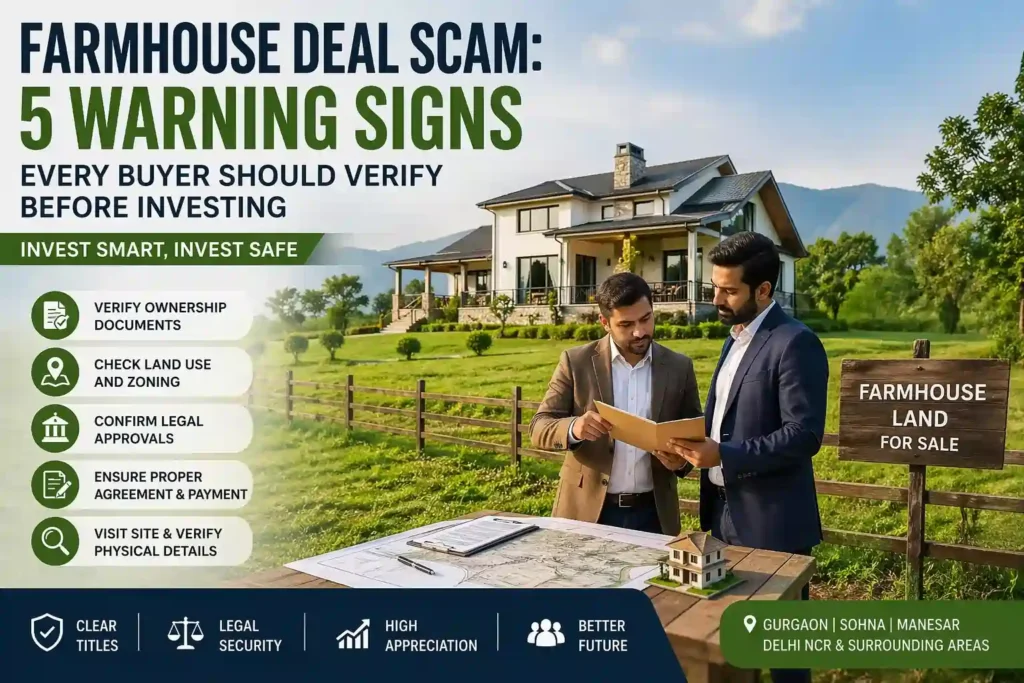
1. Certificate of Title Chain and ownership of land that is not verified.
The second step in any land transaction is to ensure that there is clear ownership and that there is clearness in the title.
In India, ownership of land is legalized by legal documents like:
- Registered sale deed
- Records of mutation (revised ownership in the records of revenue)
- Jamabandi / Khatauni (land records by the state)
- Title chain history (transfers of ownership in the past)
When these documents are not present, incomplete, or not clear, the buyer must wait and seek clarification.
In most cases of land purchase disputes, it is not a question of fraud but of unclear or conflicting ownership records. Thus, it is highly advisable to have legal confirmation by a certified property attorney or revenue authority.
Always, a legitimate farmhouse investment should be one that has a traceable ownership history.
Also Read: 𝗔𝗴𝗿𝗶𝗰𝘂𝗹𝘁𝘂𝗿𝗮𝗹 𝗟𝗮𝗻𝗱 𝗳𝗼𝗿 𝗦𝗮𝗹𝗲
2. Deficiency in Clarity in Land Use Classification.
In India land is classified as:
- Agricultural land
- Residential land
- Commercial land
- Industrial land
The farmhouse project should conform to the local land use laws and zoning.
The most important thing to check before investing is:
- The legal status of the land, i.e. whether it is agricultural or changed to residential/farmhouse property.
- In case conversion approvals (where applicable) have been received.
- The legality of construction according to the local authority regulations.
States have various regulations regarding the construction of farmhouses. To illustrate, in Haryana and the neighboring NCR areas, there are norms that regulate the development of farmhouses on agricultural land.
Always verify land classification based on official records of revenue authorities or plans.
Also Read: What Is Farmhouse?
3. Lack of Government or Authority Approvals that can be verified.
A legitimate development of land or farmhouse must conform to the local regulations. Approvals can be:
Permission of local planning authority.
- Environmental or zoning compliance (where applicable)
- Plotted developments (when a part of a project) layout approvals.
- In case a seller or developer is unable to present documentation of legal fulfillment, the buyer is advised to check with the concerned authority on his/her own.
It is worth mentioning that not every farmhouse land needs to be approved by a project like residential apartments, but the legal compliance with land use is always obligatory.
Customers must base their purchases on documents, not oral promises.
Also Read: Delhi Mumbai Expressway
4. Unfinished or unofficial Transactions Process.
A secure real estate deal in India is a legal procedure in a systematic way:
Acceptance to sell (written and signed where necessary)
- Due diligence of documents.
- Registration of execution of sale deeds.
- Post purchase mutation of revenue records.
In case a seller insists on:
- Unrecorded transactions in cash.
- Prepay without a written contract.
- Avoiding registration process
- Verbal promise or unwritten receipts.
These are some obvious signs that there is an absence of proper legal procedure.
Although this does not necessarily translate to a wrongdoing, it creates greater legal and financial risk to the buyer.
It is always important to have transactions documented and registered.
5. No Physically Verifiable Land or Site Details.
In any land purchase, physical verification is a very important procedure.
A buyer must:
- Pay a visit to the real land site.
- Check limits against revenue maps (where applicable)
- Availability of checks and the infrastructure around them.
- Ensure that the land being displayed is as per official documents.
Buyers in other instances depend solely on brochures, videos or online presentations. Although they are handy in preliminary knowledge, they cannot be used to substitute on-ground verification.
When a physical inspection is not recommended or postponed without a valid cause, it must be thoroughly considered beforehand.
Learning the difference between Risk and Fraud in Farmhouse Deals.
It is necessary to explain that not all problematic land deals are a scam. In most instances, the problems are as a result of:
- Poor documentation
- Ignorance of the law.
- Incomplete due diligence
- Miscommunication between parties
In India, the real estate market is one of the most controlled industries in regards to land ownership, yet the potential investors have to carry out their own verification before committing their funds.
The term farmhouse deal scam is typically employed in a loose sense on the Internet, yet, in reality, the majority of risks can be mitigated by adhering to the correct legal checks and documentation practices.
The Following Best Practices to make a safe farmhouse investment.
To minimize risk and have a legally sound investment, buyers ought to:
- Check government sources of land records.
- Get a competent property attorney to do due diligence.
- Write down contracts on all dealings.
- Check official records on land use classification.
- Make physical visits to site prior to payment.
- Do not use pressure when making a decision.
All these measures are highly suggested in due diligence practices of real estate in India.
Final Conclusion
Investing in farmhouse and agricultural land can be a good long term investment, provided it is done appropriately. But it needs to be closely managed with respect to legal documentation, land classification, and verification.
Buyers must look at facts that can be verified and official documents rather than at assumptions or marketing claims.
Safe investment is not a question of not investing in farmhouse property, but of making sure that all the actions of the transaction are transparent and documented.
FAQs
1. How can I find out whether a farmhouse deal in Gurgaon is authentic?
Paperwork on the ownership of checks, the land records, and identity of the seller. Go to the site and confirm the accuracy of the location before paying.
2. Will the purchase of farmhouse land in Gurgaon or Sohna be a good investment?
It is also a viable long-term investment as long as the site is well connected, there is legal certainty, and prospective of development.
3. What are the documents that I should review prior to purchasing farmhouse land in Haryana?
Check the sale deed, mutation records, revenue records, seller ID proof, and any other land use permission.
4. Am I allowed to construct a farmhouse on farm land close to Gurgaon?
It relies on the existing zoning regulations, land area and local government regulations. Never make purchases without checking the new regulations.
5. What will I do prior to paying a reservation fee on farmhouse land?
Authenticate ownership documents, visit the location, inquire about the legality, and put all the terms in writing before committing any amount of money.