
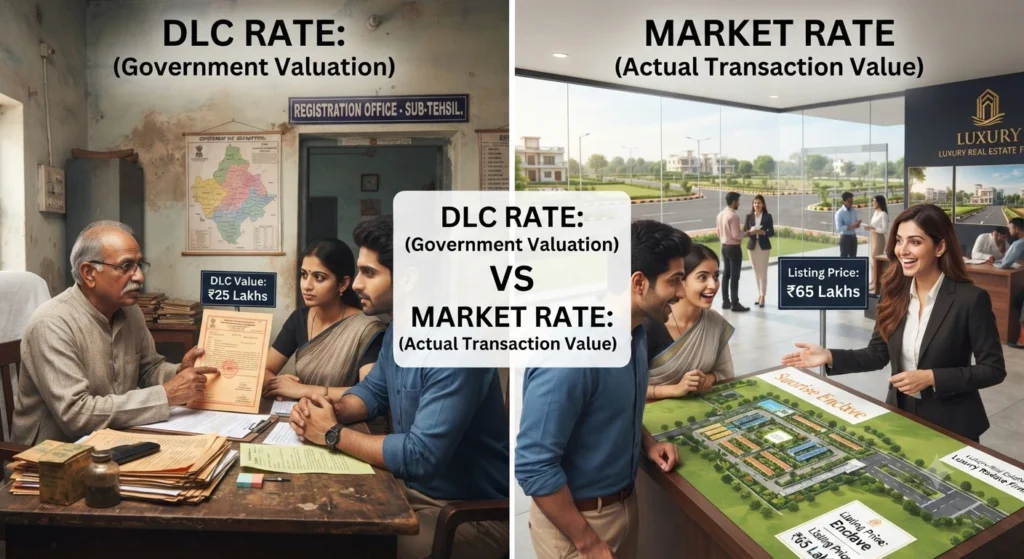
When purchasing land, a plot, or a house in India, buyers often come across two important terms—DLC Rate and Market Rate. While both relate to property valuation, they serve entirely different purposes. Understanding the difference between these two rates is essential for making informed investment decisions, calculating registration costs, and avoiding legal or financial issues.
In this guide, we’ll explain DLC Rate vs Market Rate, their importance, how they are determined, and which one matters more when buying or selling real estate.
What Is The DLC Rate?
DLC (District Level Committee) Rate, also known as the Circle Rate, Collector Rate, or Guideline Value in different states, is the minimum property value fixed by the state government for property registration.
The government uses the DLC rate to calculate:
- Stamp duty
- Registration charges
- Government property valuation
- Tax assessment
No property can generally be registered below the applicable DLC rate, even if the buyer and seller agree on a lower transaction price.
Example
Suppose the DLC rate of a residential plot is ₹20,000 per sq. meter.
If you purchase a 200 sq. meter plot, the minimum government valuation becomes:
200 × ₹20,000 = ₹40,00,000
Stamp duty and registration charges will be calculated on at least ₹40 lakh.
What is the Market Rate?
The Market Rate is the actual price at which a property is bought or sold in the open market. It depends entirely on demand, supply, location, infrastructure, and buyer interest.
Unlike the DLC rate, the market rate changes frequently and reflects real-world property values.
For example, the same property with a DLC valuation of ₹40 lakh may sell for ₹60 lakh because of strong demand and excellent location.

DLC Rate vs Market Rate: Major Differences
| Feature | DLC Rate | Market Rate |
|---|---|---|
| Fixed By | State Government | Buyers & Sellers |
| Purpose | Registration & Stamp Duty | Property Purchase/Sale |
| Changes | Periodically | Based on Market Conditions |
| Legal Importance | Mandatory Minimum Value | Actual Transaction Value |
| Usually | Lower | Higher |
How is the DLC Rate Determined?
The District Level Committee considers several factors before fixing the DLC rate, including:
- Property location
- Road width
- Commercial or residential use
- Nearby infrastructure
- Government development plans
- Previous property registrations
- Urban or rural classification
These rates are revised periodically to reflect changing property values.
How is the Market Rate Determined?
The market rate depends on real estate demand and several practical factors such as:
1. Location
Prime areas command significantly higher prices than developing locations.
2. Connectivity
Properties near highways, metro stations, airports, and expressways generally have better market value.
3. Infrastructure
Schools, hospitals, shopping malls, parks, and business hubs increase demand.
4. Future Development
Upcoming projects like industrial corridors, IT parks, and expressways often boost market prices.
5. Demand and Supply
Limited supply with high demand naturally drives prices upward.
Why is the Market Rate Usually Higher Than the DLC Rate?
The DLC rate is intended to establish a minimum value for registration purposes and may not keep pace with rapid market appreciation.
For example:
- DLC Rate: ₹15,000 per sq. yd.
- Market Rate: ₹22,000 per sq. yd.
The additional value reflects buyer demand, location advantages, infrastructure improvements, and future appreciation potential.
Which Rate is Used for Property Registration?
The government compares:
- DLC Rate
- Actual Sale Value
Whichever is higher becomes the basis for calculating stamp duty and registration fees.
Example
Property Sale Price: ₹80 lakh
DLC Value: ₹70 lakh
Registration will be based on ₹80 lakh.
If the sale price is ₹65 lakh while the DLC value is ₹70 lakh, the registration charges will still be calculated on ₹70 lakh.
Importance of DLC Rate for Buyers
Knowing the DLC rate helps buyers:
- Estimate stamp duty costs
- Avoid undervalued transactions
- Verify government valuation
- Calculate registration expenses
- Ensure legal compliance
Importance of Market Rate for Investors
The market rate helps investors:
- Understand the property’s actual worth
- Negotiate effectively
- Estimate future appreciation
- Compare nearby properties
- Assess investment potential
Can Market Rate Be Lower Than DLC Rate?
Yes, although it is uncommon.
This may happen during:
- Economic slowdowns
- Distressed sales
- Oversupply in a locality
- Legal disputes affecting the property
- Low-demand rural markets
Even in such cases, registration charges are generally calculated using the DLC rate if it is higher.
How to Check the DLC Rate?
You can verify DLC rates through:
- State government registration portals
- Local Sub-Registrar Office
- Revenue Department websites
- Authorized property consultants
- Government e-registration services
Checking the official DLC rate before purchasing property helps avoid surprises during registration.
Tips Before Buying Property
- Compare the DLC rate with the market rate.
- Research recent property transactions in the area.
- Verify ownership documents.
- Check future infrastructure developments.
- Calculate registration expenses beforehand.
- Consult a qualified legal or real estate expert if required.
Conclusion
Understanding DLC Rate vs Market Rate is essential for every property buyer and investor. While the DLC rate represents the minimum government valuation for registration and taxation, the market rate reflects the property’s actual value based on demand, location, and future growth potential.
A smart buyer should always evaluate both rates before making a purchase. Comparing the DLC rate with the market rate helps estimate the true investment value, registration costs, and long-term appreciation potential. Whether you’re buying agricultural land, residential plots, commercial property, or a farmhouse, knowing the difference between these two valuations can help you make a confident and financially sound decision.