
The Rajasthan land documents are the legal documents that prove who the landowner is and whether it’s free from disputes or not; they are Jamabandi, Khasra, Mutation entries, sale deed registered documents, etc. If you’re looking to purchase farmland or a plot of a farmhouse in the Naugaon belt in Alwar, it is not something you can do after the deal is done; it is something you need to understand before you buy it.
This guide explains in layman’s terms for a buyer all the documents and processes he/she must be aware of before signing any document. It’s based on our own document-verification process for Naugaon Farms buyers and is verified against official Rajasthan government portals.
What Is Jamabandi in Rajasthan?
The Official Record of Rights (RoR) is Jamabandi, which records the landowner/owner(s), the extent of land owned, and how the land is utilised. It is the most crucial document for any land deals in Rajasthan, as it is the government’s own record of land ownership and not the seller’s.
The Jamabandi records in the state of Rajasthan are being digitised under the Apna Khata (e-Dharti) initiative by the revenue department of the government. With this Jamabandi Nakal (certified copy), buyers can pull it up online with the Khata or Khasra number without visiting the Patwari office. If the Jamabandi is over a few years old, or there is no matching name on the Jamabandi to the seller, it’s a big red flag to investigate further before proceeding — check our documentation checklist and due diligence guide for the entire verification process.
What Is a Khasra Number and Why Does It Matter?
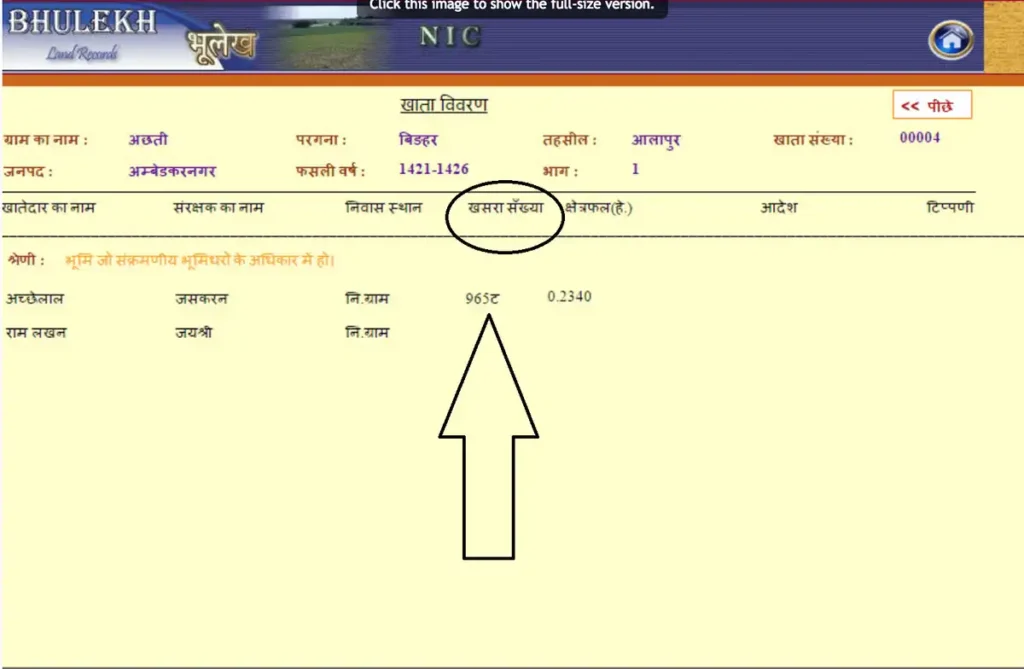
The identification number of a particular piece of agricultural land in the village revenue map is called a khasra number. All plots, including farms in Naugaon, have one, and it is used to pull that particular plot’s Jamabandi, boundary map (Bhu Naksha) and ownership history.
The number on the sale documents must match the Khasra number on the village revenue map and the Jamabandi record before purchase. If there is a mismatch, either it necessitates a clerical error that must be corrected at the Tehsil office, or it means that the plot on display is not the plot that is being sold on paper — a typical boundary shifting scam.
What Is Land Mutation (Dakhil-Kharij) in Rajasthan?
A process of updating the revenue records when ownership changes due to sale, gift, or inheritance is called ‘mutation’, or ‘Dakhil-Kharij’ in Rajasthan. There is a difference between the registration of a sale deed and the mutation, which makes the transaction of a sale deed a change in the government records. Without mutation, the previous owner’s name can still be seen on government records.
The status of the mutations can be verified directly through the Apna Khata portal. When buying resale farmland, buyers should always verify with the seller that their own mutation was undertaken after they bought the land; otherwise, the mutation chain may be incomplete, and there could be uncertainty as to who the landowner is today. This is the same check that we perform on our land consultation service before we give you the thumbs up to a resale plot.
What Is the Land Registry Process in Rajasthan?
Registration is a legal process of recording a property sale with the state government, which is recorded at the sub-registrar’s office and becomes public record. This is controlled by the Inspector General of Registration & Stamps (IGRS) using e-Panjiyan and Rajnivesh portals to calculate stamp duty, book appointments and pay e-stamps in Rajasthan.
The usual process: checking the DLC rate of land and preparing and executing the sale deed; payment of stamp duty and registration fee; booking of a Sub-Registrar Office slot through Rajnivesh; and biometric verification and submission of documents in person with the Sub-Registrar Office. Even if the paperwork seems complete, an unregistered sale does not turn the paperwork into a legal sale. If it’s your first purchase, we will accompany you with our legal land consultation service, which will take care of you step by step.
DLC Rate vs Market Rate: What’s the Difference?
DLC (District Level Committee) rate is the minimum price that the government has fixed for legal registration of land in a particular area, which is useful to calculate the stamp duty and to ensure that land transaction value is not underreported. The market rate is the price that is agreed upon by the buyer and the seller and may be higher or lower than the DLC rate depending on the market conditions, infrastructure and negotiation.
The registration cost is directly linked to the DLC rate of a plot, as the higher of the two rates (DLC or declared transaction) is paid as the stamp duty. Any locality’s current DLC rates can be examined on the e-Panjiyan portal prior to any dealings. The rate of Naugaon/Alwar-specific DLC figures will be adjusted from time to time and should be pulled freshly from e-Panjiyan at the time of transaction. If you want more insight into the pricing of the agricultural land in this belt then read our agricultural land buying guide.
Agricultural Land vs Residential Land: Key Differences
In the state of Rajasthan, agricultural lands are zonally designated for agricultural purposes and have only a few types of permissible activities, such as a farmhouse or a storage house on a small portion, without a formal agricultural land conversion process. Residential land is a type of land that has been subject to the change of land use process and is legally able to be built on for permanent housing, having access to home loans, plan approvals and much more.
The difference to a person who wants to buy the land is that agricultural land is usually more affordable and is normally provided by the khatedari (tenancy) system, while residential land is provided by the clear title system, which allows it to be built upon and resold as built land. Even within a “farmhouse project”, the land upon which the building is being constructed may not have ever been formally converted, posing a legal risk when a full residence is being built on it. For a full guide on what does and doesn’t make a farmhouse, read this.
What Is the Land Conversion (CLU) Process in Rajasthan?
The official government permission for the change of land use from agricultural use to residential/commercial/farmhouse use is called a CLU. It doesn’t matter what is on or marketed from the land or how it is marketed; if it is not agricultural land, it is not legal agricultural land.
In Rajasthan, the Tehsildar (for rural areas) or the local Urban Improvement Trust (UIT) / Development Authority (for urban planning areas) — depending on the location of the plot — will be responsible for the conversion. There are rules in place which govern conversion, including the issuance of a conversion order and payment of conversion charges, which can be calculated either as a percentage of the rate of the DLC or a fixed fee per square metre. It is important for farmhouse purchasers to always request this order upfront and not assume it is correct based on the developer’s word. Our CLU consultation service checks this just before you buy — check out our detailed CLU consultation guide and how CLU can sometimes be misapplied in NCR real estate.
How to Verify Land Ownership Before Buying?
Properly verifying ownership means confirming that the landowner named on all government documents is the same person who is selling the land and not some other person. This involves cross-checking Jamabandi, mutation history, Khasra map, and identity documents of the seller.
Accessing the online current Jamabandi to confirm the seller’s name, checking the mutation status of the latest transfer, checking the Khasra number with the site boundary and asking for an Encumbrance Certificate are all good verification procedures. There may be some differences between these sources; even if it is in their name in different spellings in the different sources, they would be considered a difference and will need to be fixed through a query from the Tehsil office before payment. This is identical to the process our land consultation team goes through on every plot before listing.
What Is an Encumbrance Certificate and Why Does It Matter?
Encumbrance Certificate (EC): An official certificate verifying whether a property is free from registered loans, mortgages and/or legal claims for a specific period of time. One of the few papers that directly answers the question “Can this land be sold to me free and clear?
The EC is verified from the registration record at the sub-registrar’s office or can be sought through e-Panjiyan for transactions in the farmlands of the State of Rajasthan. While a clean EC wouldn’t mean there are no disputes, it would also mean that the property has no outstanding mortgage or lien, and that would definitely be a reason to pause the transaction until it’s cleared. This can be pulled and interpreted by our legal land consultation service.
What Are Revenue Records and Why Do They Matter?
The larger group of land records by the government (Jamabandi, Khasra, Khatauni, mutation registers, and village maps) that collectively define land ownership, boundaries and usage classification in Rajasthan is known as revenue records. They are kept in the Revenue Department and not the Registration Department, so it is necessary to check with the Registration Department as well as the Revenue Department.
A sale deed does not show the type of land, whether agricultural or not, nor does it reveal whether the land has been used for its original purpose or for another purpose; nor does it show whether the ownership history of the land has been continuous or whether the area recorded as the land has been sold. One of the most frequent omissions that permits fraudulent sales to go unnoticed is reliance on the sale deed provided by a broker, without attempting to obtain independent revenue records.
What Is a Patwari Record and How Is It Used?
A Patwari record is the land record kept by the Patwari (local revenue official in charge of a Patwar circle) on the local level, which is now being increasingly digitised. Jamabandi copies and mutation entries were formerly only available at the Patwari’s office, but in most cases these can now be accessed via Apna Khata; the Patwari on the ground will be the last resort for physical verification of boundaries or dispute resolution.
Though online access is available, it is advisable to have a Patwari or land consultant verify that the boundaries of the plot are confirmed to match the Khasra map. This is an on-ground confirmation and is not considered a substitute for site photos or verbal agreements from a seller/agent.
What Are Illegal Colonies and How to Identify Them?
An illegal (unauthorised) colony is a residential development that has been laid out and sold without permission from the relevant planning authority – that is, without a layout plan (sanctioned) being approved by the planning authority, nor formal land conversion, or any legal basis for construction or registration. These colonies can appear to be complete, with roads and plotted layouts, which is what makes them convincing to purchasers.
Signs to look out for include the land still being designated as agricultural on the Jamabandi even though it is being sold as “residential plots”; no visible CLU or layout sanction number; pricing significantly lower than the area’s DLC rate; and the seller not being keen on sharing revenue documents in advance. When buying a farmhouse plot, it is always advisable to check if the layout has been officially approved before committing any farmhouse project to legal residential use, as outlined in our farmhouse deal scam prevention guide.
What to Check for Court Cases on Land?
A property that has a pending lawsuit, or a “sub judice” property, cannot be safely purchased, even if it seems to be otherwise clear, because a court decision could cancel any sale made during the intervening time. The presence of litigation is not always apparent on the Jamabandi, and therefore a separate check is required.
A property lawyer should be asked by the buyer to conduct a legal search report or a title search that includes verification of civil court records, revenue court records and any pending litigation related to the Khasra number or the seller’s name. This is especially important for inherited property or land that has been passed through several hands, as conflicts between co-heirs and among previous owners are common and often unrecognised as hidden litigation.
Common Land Frauds in Rajasthan (and How to Avoid Them)
Some scams seem to occur over and over again in the land transactions going on in Rajasthan, and if you know them you’ll never become a victim. Properly made or expired Power of Attorney documents are used to resell land that the “seller” has no authority over. Duplicate sales occur when the same property is sold to more than one purchaser under the guise of improper and/or delayed revenue recording. Misrepresentation of boundaries is when a buyer is shown one parcel on site and the documentation lists another, frequently less desirable, parcel. The agricultural land associated with the site (if any) that is being marketed as residential is sold at residential-adjacent pricing without a CLU. Payments for plots of land within colonies are made for fake or unregistered developer projects which were never approved by any planning body.
What they all share is the fact that they depend on a buyer not to verify documents independently. These patterns are identified nearly before money changes hands, through the following checks: Pulling the Jamabandi directly from Apna Khata, checking mutation status, verifying the Khasra map and obtaining a lawyer’s title search. See our land consultant walkthrough for details and a walkthrough for the steps you should take before investing and our detailed scam warning signs post.
Land Verification Checklist for Naugaon Farmhouse Buyers
- Read the current Jamabandi Nakal from Apna Khata and verify the name of the owner
- Check Khasra No. with site boundary and Village map
- Ensure that the latest ownership transfer check is performed – mutation status.
- Verify current rates on e-Panjiyan for the locality for the DLC.
- Request the Encumbrance Certificate
- Verify CLU/conversion order if the land is being sold as residential or for farmhouse construction
- Ensure that the layout is properly approved by the planning authority (where relevant) for a plotted project.
- Have a title search conducted by a lawyer for any pending litigation.
- Have a member of the local team confirm boundaries in the field
That’s what our Land Consultation and CLU consultation are all about — verifications independent of compliance before you commit to it, not after. You can also download our full documentation checklist and due diligence guide for a printable version of this list.
If a plot has already been verified and you are looking at what’s available at the moment, then simply check out our listed farmhouse projects in Naugaon.
Frequently Asked Questions
The current owner of the land is reflected in Jamabandi, and mutation is the process of changing the Jamabandi after the sale, inheritance, or gift of the land to the new owner.
Yes, the Apna Khata (e-Dharti) portal of the government of Rajasthan lets anyone search Jamabandi Nakal, Khasra details and mutation status online without travelling to the Patwari office with the help of the Khata number or Khasra number.
Agricultural land may be available for purchase but before the legal purchase of a permanent residence, formal land conversion (CLU) must be secured on the agricultural land (otherwise, there is a legal and financing risk).
Rajasthan law provides that no unregistered sale agreement can give rise to a legal title; it is only a registered sale deed with mutation that gives recognition to a legal title.
Do not rely on marketing material – request the layout sanction from the planning authority (in rural areas, the Tehsildar; and in urban areas, the UIT/Development Authority) and also check the sanction independently.